A Poor Load Path – Inducing Bending
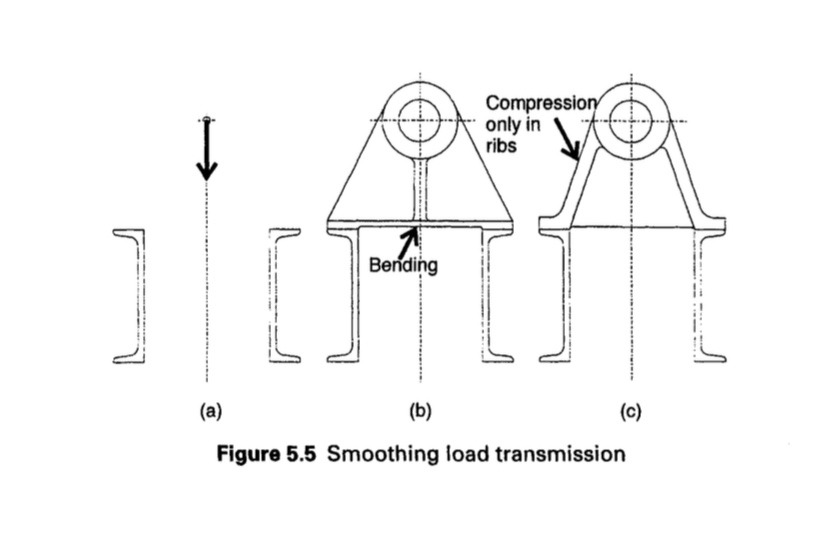
The configuration in Figure 5.5(b) represents a poor design choice. Here, a single vertical web is placed beneath the bearing. When the load is applied downward, it acts directly on the central region of the bearing block, but the support exists primarily only at the sides through the channel flanges.
Bending introduces:
- Higher and localized stresses
- Reduced structural efficiency
- Increased material thickness requirements
This leads to heavier and less economical components without real structural benefit.
The load is not traveling in a straight, supportive path. Instead, the structure is “forced to bend” itself to transfer that force, which is undesirable.
A Smarter Load Path – Compression Only
The improved configuration is shown in Figure 5.5(c). Instead of relying on a single vertical rib, two inclined ribs are used, directing the load diagonally outward toward the supporting channel flanges. These inclined ribs align themselves with the natural flow of the applied load.
As a result:
- The ribs work primarily in pure compression.
- Bending stresses are minimized.
- Smooth load transition from bearing to supports.
- Stronger and lighter design.
Rather than fighting bending, we redesign the geometry to eliminate it.
Rethinking Traditional Designs
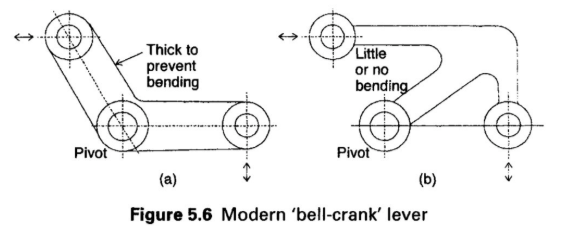
This way of thinking often challenges long-standing design habits. A classic example is the bell-crank lever where redesigning for direct load paths can reduce material usage by up to 50% while maintaining the same performance.
Key Engineering Insight
Efficient structural design is not only about resisting loads; it is about managing the path those loads travel.
- Direct paths = compression or tension = efficient designs
- Interrupted paths = bending = heavier designs
By consciously shaping components to guide loads intelligently, engineers achieve superior performance with less material.